Introduction
Look around any hospital, office, or car interior and you're surrounded by contract-sewn products. Car seats, hospital gowns, office chairs, luggage — none of these get made without specialized sewing manufacturers working behind the scenes.
Many businesses hit a wall when demand for custom fabric or soft goods outpaces what they can build in-house. Without technical textile expertise or industrial equipment, scaling production becomes a real bottleneck.
That's where contract sewing comes in. SEAMS, the trade association for the US sewn-products industry, represents more than 200 brands, retailers, manufacturers, and textile providers spanning apparel, industrial, and home-furnishings markets. This is a cross-sector manufacturing category, not a niche apparel service.
This article breaks down what contract sewing actually involves, the industries it serves (including commercial furniture upholstery), how the production process works, and what to look for when choosing a partner.
Key Takeaways
- Contract sewing outsources cut-and-sew work so brands get skilled labor and industrial capacity without an in-house shop
- Medical, hospitality, marine, and commercial furniture upholstery use it for consistent, scalable production
- Typical projects move through prototyping, pattern development, sourcing, cutting, and stitching
- The right partner offers certifications, material expertise, and consultative project management
What Is Contract Sewing?
Contract sewing is a manufacturing service that produces soft goods, textile assemblies, and sewn components using trained personnel and industrial-grade equipment. A business supplies the design, specifications, or materials, and the contract sewer handles fabrication.
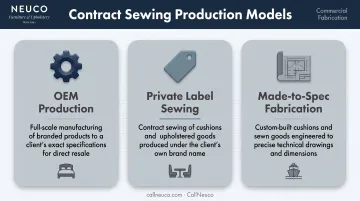
These providers typically fall into three production models:
- OEM production: building components or finished products for another company's branded product line
- Private label sewing: supplying an existing product design that the buyer rebrands with its own logo
- Made-to-spec fabrication: manufacturing an entirely custom design built from the client's own drawings and requirements
Contract sewers often work with smaller production runs than large-scale apparel factories, sometimes fewer than 100 pieces per order. That flexibility matters for buyers who need custom quantities rather than mass-market volume.
Material versatility separates a strong contract sewing partner from a weak one. Look for experience across:
- Vinyl, vinyl-coated nylon, and canvas
- Leather, faux leather, and upholstery-grade textiles
- Neoprene, polyester, and cotton
- Felt and specialty technical fabrics (marine, outdoor, medical)
The difference between contract sewing and home or hobby sewing is precision at scale. A contract sewer builds the 500th unit to the same tolerance as the first. A single machine at home can't guarantee that repeatability.
Basic Sewing Terms Every Buyer Should Know
Miscommunication during quoting or prototyping gets expensive fast. Knowing a handful of terms helps you spec a project accurately:
- Stitch: the individual loop or interlacing of thread that holds material together
- Seam: a sequence of stitches joining two or more pieces of fabric
- Bar tack: a small, dense cluster of stitches reinforcing high-stress points like pocket corners or straps
- Lockstitch: a needle-and-bobbin stitch (ISO type 301) that creates a tight, low-bulk, durable seam
- Bobbin: the spool holding the lower thread that interlocks with the needle thread to form a stitch
- Grommet: a reinforced ring inserted into fabric to prevent tearing around a hole, often for lacing or hardware
Walking into a quote conversation with this vocabulary means fewer revisions, faster prototypes, and a lower chance of costly surprises mid-production.
Industries and Applications That Rely on Contract Sewing
Contract sewing shows up anywhere a product needs sewn fabric assembled to exacting, repeatable standards. A few sectors stand out.
Automotive & Transportation
Seat upholstery, airbags, and restraint systems all demand safety-compliant stitching. Seat-belt assemblies fall under federal performance standards governing webbing strength, elongation, and hardware durability: stitch quality isn't cosmetic, it's a safety requirement.
Medical & Healthcare
Surgical drapes, patient positioning aids, and sterile fabric products require regulatory compliance around liquid-barrier performance and infection control. These aren't off-the-shelf items; they're built to classification standards that govern everything from seam construction to material permeability.
Military, Safety & Aerospace
Uniforms, high-visibility apparel, protective gear, and aerospace textiles often carry domestic-sourcing requirements alongside strict performance standards for visibility, flame resistance, or structural load.
Consumer & Industrial Goods
Luggage, industrial curtains, aprons, and equipment covers get produced at scale for both OEMs and private-label brands looking to avoid building their own sewing floor.
Commercial Furniture & Upholstery
Contract sewing also supports commercial furniture programs—replacement cushions, custom covers, and OEM or white-label upholstery for offices, healthcare facilities, hospitality spaces, and similar environments that need matched fabric and consistent build quality without standing up an in-house sewing line.
Commercial-grade fabric has to hold a seam under real use. The Association for Contract Textiles' 2025 guideline for woven upholstery fabrics sets a minimum seam slippage requirement of 25 lb in both warp and weft directions under ASTM D4034 testing. That benchmark separates fabric built for daily commercial wear from fabric that isn't.
Neuco, based in Traverse City, Michigan, manufactures custom cushions, upholstery, and contract-sewn goods for commercial clients—including restaurants, hotels, healthcare facilities, and designers who need repeatable specs at project scale. Work covers white-label and OEM runs as well as single-space or full-facility orders, with collaboration on fabric and color so sewn components match the broader furniture program.
The Contract Sewing Process
Every reputable contract sewing operation follows a similar production sequence, even when the end product varies widely.
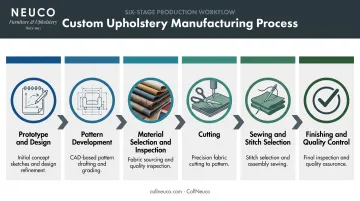
- Prototype and design — Build an initial sample to catch design flaws, confirm materials, and validate fit before full production
- Pattern development — Use CAD for digital patternmaking, sizing, and seam allowances to cut down on manual drafting errors
- Material selection and inspection — Source fabrics, threads, and fasteners, then inspect them for defects and performance before cutting
- Cutting — Use manual cutting for low-volume or highly custom jobs; use CNC cutting to hold waste down and consistency up on larger runs
- Sewing and stitch selection — Match stitch type to the fabric and end use so seams hold up in real-world conditions
- Finishing and quality control — Trim threads, add labels or hardware as specified, and check seams, dimensions, and workmanship before shipment
Stitch choice isn't arbitrary:
- Lockstitch (ISO type 301): Tight, strong, low-bulk seam for structural joins
- Zigzag: Allows lateral thread movement where fabric must stretch or raw edges need coverage
- Bar tacks: Reinforce high-stress points such as strap corners and handle bases
Simple, straight-seam products are the easiest candidates for sewing automation. Complex upholstery, curved seams, and multi-material assemblies still need skilled operators. That experienced labor remains the backbone of quality contract sewing.
How to Choose the Right Contract Sewing Partner
Not every contract sewer fits every project. A few evaluation criteria separate a dependable partner from a risky one.
Check certifications and quality systems. ISO 9001:2015 defines quality management system requirements covering organizational context, planning, operations, and continuous improvement. Certification is voluntary, so ask who issued it, what site it covers, and when it expires.
ISO 9001 confirms the quality system is sound, but it doesn't automatically mean every product meets industry-specific standards like FMVSS or FDA classifications. Ask for product-specific test evidence separately.
Assess material and industry expertise. A sewer skilled in lightweight apparel fabric won't necessarily handle marine-grade vinyl or medical-grade barrier fabric well. Ask for examples of past work in your specific material category.
Prioritize consultative, end-to-end project management. The strongest partners manage the whole process, not only stitching:
- Design collaboration from the earliest concept stage
- Material and color selection support
- Ordering, delivery, and installation coordination
This matters most in specialized work like commercial furniture upholstery. Partners such as Neuco manage the full color, fabric, and installation process alongside designers and architects, turning a multi-step procurement headache into a single point of contact.
Frequently Asked Questions
What are the basic sewing terms?
Key terms include stitch (a single thread loop), seam (a joined line of stitches), bar tack (reinforcement stitching), and lockstitch (a tight, durable stitch type). See the glossary section above for full definitions.
What industries use contract sewing the most?
Automotive, medical, military, aerospace, and commercial furniture upholstery are the heaviest users, along with consumer goods like luggage and equipment covers.
How do I choose the right contract sewing company for my project?
Evaluate their certifications like ISO 9001, confirm they have direct experience with your specific material category, and prioritize partners offering collaborative, end-to-end project management.
What materials can contract sewing companies work with?
Providers typically handle natural fibers like cotton and leather alongside synthetics such as vinyl, nylon, polyester, and neoprene, depending on the project.
Is contract sewing more cost-effective than in-house production?
It avoids the equipment, labor, and floor-space overhead of building an in-house sewing operation, and it scales up or down with demand. Total cost still depends on volume, complexity, and your existing capacity.
Can contract sewing be used for furniture upholstery projects?
Yes. Contract sewing supports commercial furniture refresh and custom upholstery projects, including custom color and fabric matching for offices, restaurants, hotels, and healthcare facilities.