
Many business owners hit the same wall when starting a remodel or build-out: they don't know which design disciplines they actually need. An architect? An interior designer? A furniture vendor? All three? Scoping a project wrong leads to blown budgets, missed code requirements, and furniture that never matches the vision.
This guide breaks down what commercial design services actually cover, who delivers them, and where furniture upholstery and customization fit into the bigger picture — because that piece gets overlooked more often than it should.
Key Takeaways
- Commercial design covers space planning, architecture, interior finishes, and furniture selection
- Most projects need architects, interior designers, and specialty vendors collaborating as one team
- Professional design improves functionality, brand consistency, and long-term ROI
- Furniture upholstery and customization are often the most overlooked part of a remodel or refresh
- The right partner collaborates with your design team, manages full logistics, and scales to any project size
What Are Commercial Design Services?
Commercial design services cover the professional planning, design, and furnishing of non-residential spaces — offices, retail stores, healthcare facilities, restaurants, and hotels. Unlike decorating a home, these projects have to perform under constant public use while meeting strict legal and safety requirements.
That's what separates commercial design from residential design:
- Code compliance — ADA rules on new construction and many alterations (doorway widths, seating clearances, accessible routes)
- Durability — furniture and finishes built for daily traffic and tested to abrasion/wear standards residential products never face
- Brand alignment — every finish, fixture, and furniture piece reinforces company identity, not personal taste
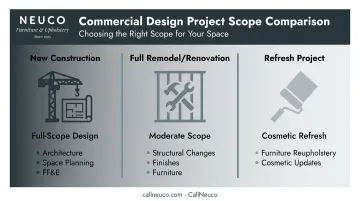
The full scope runs from initial space planning and architecture through interior finishes, lighting, and furniture, fixtures, and equipment (FF&E) selection. It applies across three project types: new construction, full remodels or renovations, and smaller refresh projects that update a space without gutting it.
This isn't a niche industry, either. BIFMA's U.S. business and institutional furniture market alone was estimated at $15.228 billion in preliminary 2023 figures — and that's just the furniture segment, not the full architecture and design services market layered on top of it.
Who Delivers Commercial Design Services
These services rarely come from one company. Most projects rely on a network of specialists:
- Architecture firms handle structural design and permitting
- Interior design studios manage layout and finishes
- Specialty vendors (furniture and upholstery providers) handle FF&E sourcing, customization, and installation
Some specialty vendors do more than supply products. Neuco, for example, reviews architectural drawings and builds furniture layouts for capacity, traffic flow, and comfort, and coordinates with the client's architect or designer to execute the overall vision.
Types of Commercial Design Services
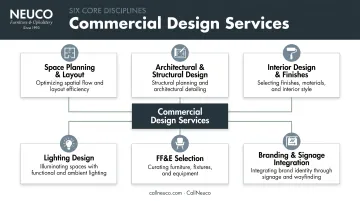
Commercial design breaks down into several distinct disciplines, each solving a different problem.
Space Planning & Layout Design
Designers map traffic flow, workstation layouts, and zoning to balance efficiency with code compliance. They factor in accessible routes, furniture clearances, and wheelchair turning radii before anyone chooses a finish.
Architectural & Structural Design
This covers building shell modifications, permitting, and structural changes required for new construction or major remodels. Architects typically move through schematic design, design development, construction documents, and construction administration.
Interior Design & Finishes
Designers select flooring, wall treatments, paint, and material palettes to create a cohesive look throughout the space. Choices also weigh durability, maintenance, and how finishes reinforce the brand in high-traffic commercial areas.
Lighting Design
Lighting plans influence ambiance, energy use, and functionality. Combining daylighting, occupancy sensors, and task lighting can cut energy costs while improving how a space feels.
Furniture, Fixtures & Equipment (FF&E) Selection
This category covers furniture sourcing, custom upholstery, and fabric and color coordination. Specialty upholstery partners often support designers and architects on execution—matching specs, fabricating pieces, and keeping finishes consistent across the project.
Branding & Signage Integration
Teams weave brand colors, logos, and signage into the physical space, tying environmental graphics and wayfinding back to the company's identity.
Benefits of Investing in Commercial Design Services
Good design changes how a space functions, not only how it looks.
Workflow Efficiency and Space Utilization
Thoughtful layout planning reduces congestion, shortens walking distances between workstations, and improves how staff move through a retail floor or office. A well-planned reception area, for instance, can cut perceived wait times simply by improving sightlines and flow toward service points.
Brand Image and Employee Experience
Design decisions shape client first impressions and how employees experience the workday. Gensler's 2023 survey of 4,026 U.S. office workers found employees spend about 48% of a typical week in the office, yet reported peak productivity when spending about 63% of the week there. That gap points to workplace design as a lever companies can pull to close it.
Long-Term Cost Savings
Durable material choices pay off over time. Instead of replacing worn furniture every few years, businesses that invest in commercial-grade materials upfront, or refresh existing pieces instead of buying new, stretch their furniture, fixtures, and equipment (FF&E) budget considerably further.
The Role of Furniture Upholstery & Customization in Commercial Design
Furniture is where a lot of commercial design plans either succeed or fall apart. Poor fabric choices wear out fast under daily use, and mismatched colors undo an otherwise cohesive design scheme. Upholstery quality directly affects durability, comfort, and brand alignment, not just how a chair looks on day one.
Refresh vs. Replace
Full furniture replacement isn't always necessary or smart. Reupholstering sound frames with new fabric and color schemes is often a cost-effective, more sustainable alternative. Facility managers are already moving away from always buying new. IFMA's 2024 benchmark found 49% of furniture purchased that year was used or refurbished, up from just 16% in 2002. Reupholstery follows the same cost and sustainability logic on pieces you already own.
Custom Fabric and Color Matching
Custom fabric and color matching lets businesses align furniture with specific brand guidelines or an interior designer's vision, rather than settling for whatever a manufacturer has in stock. This typically involves:
- Selecting from commercial-grade fabric partners for durability and appearance
- Matching colors to existing brand standards or design boards
- Coordinating custom pillows, cushions, and banquette seating with no minimum order requirements
A Collaborative Execution Model
Upholstery specialists usually don't work in isolation. They partner directly with designers and architects to execute the intended look for a space, handling the fabrication and installation side while the design team drives the creative direction.
Neuco is built around that model: a commercial furniture upholstery and customization partner that works directly with design and architecture teams. The company handles on-site or in-shop work, plus ordering through delivery and installation, for new construction, remodels, and smaller refreshes.
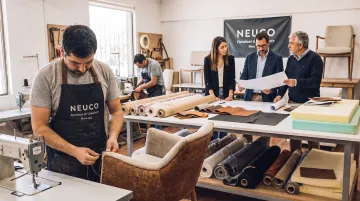
That same flexibility applies across office, hospitality, and healthcare. Design teams get one partner for fabric, fabrication, and install instead of coordinating separate vendors.
How to Choose the Right Commercial Design Partner
Not every vendor fits every project. A few things separate a strong partner from a risky one:
- Strong collaboration skills — choose a partner who integrates with your design or architecture team rather than competing with it.
- Relevant portfolio and experience — look for demonstrated work in your project type and industry, whether healthcare, hospitality, or office environments.
- End-to-end project management — confirm they handle ordering, delivery, and installation directly so your team carries less coordination burden.
- Scalability — pick a partner who can handle a single-chair repair as well as full-building FF&E procurement.
Asking for references or examples of long-term client relationships is a good way to gauge reliability before committing to a full project.
Frequently Asked Questions
What is the difference between commercial design and residential design?
Commercial design prioritizes code compliance, durability, and brand alignment for high-traffic, non-residential spaces. Residential design focuses on personal lifestyle preferences and doesn't carry the same accessibility or performance requirements.
How much do commercial design services typically cost?
Costs vary widely based on project scope, square footage, and whether it's new construction, a full remodel, or a smaller refresh. Get a project-specific quote rather than relying on general estimates.
Who needs commercial design services?
Businesses undergoing construction, renovation, or a furniture refresh typically benefit from these services. Designers and architects managing commercial projects also rely on specialty vendors for FF&E sourcing and execution support.
Can existing furniture be reused in a commercial redesign?
Yes. Reupholstering existing furniture with new fabric and color schemes is often a cost-effective alternative to full replacement, especially when the underlying frame is still in good condition.
How long does a typical commercial design project take?
Timelines depend heavily on project size and type, ranging from a few weeks for a furniture refresh to several months for new construction involving permitting and structural work.
Do commercial design services include furniture upholstery and repair?
Yes. FF&E selection, including custom upholstery, fabric sourcing, and repair, is a core component of comprehensive commercial design services.