
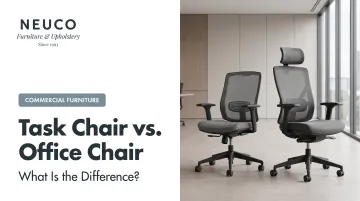
For businesses and designers, that distinction isn't just semantics. Pick the wrong seating and you'll deal with employee discomfort, higher long-term replacement costs, and a reception area or workstation that looks mismatched to the rest of your space.
This guide breaks down what actually separates the two, when each makes sense, and how to extend the life of seating you already own instead of defaulting to a full replacement order.
Key Takeaways
- Task chairs suit shared, rotating, or short-duration seating (an hour or two at a time)
- Office chairs (ergonomic and executive styles) are built for 6-8+ hours of dedicated daily use
- Key differences: adjustability, lumbar support, footprint, and price
- Choose based on sitting duration, space, and budget rather than the product label
- Worn chairs don't always need replacing; reupholstery can refresh both look and lifespan
Task Chair vs. Office Chair: Quick Comparison
Here's the side-by-side breakdown facility managers and designers need:
| Factor | Task Chair | Office Chair |
|---|---|---|
| Cost | Lower upfront cost, simpler build | Higher cost, especially ergonomic/executive models |
| Design | Smaller frame, lightweight, mid-back or no headrest | Larger frame, full-back support, often includes headrest |
| Adjustability | Basic height and swivel; arms sometimes fixed | Multiple points: lumbar, seat depth, tilt tension, armrests |
| Ideal Duration | 1-2 hours or rotating shared use | 6-8+ hours of continuous work |
| Portability | Lightweight, easy to move between stations | Bulkier, typically assigned to one workstation |
Industry standards bodies like BIFMA classify executive and management seating within the broader "general-purpose office chair" category rather than as a separate class. The label on a chair matters less than its adjustment features and build quality when you're comparing options.
What Is a Task Chair?
A task chair is a compact, mobile seating solution designed for shorter or shared desk sessions rather than all-day dedicated use. Think hot desks, reception counters, and conference rooms: spaces where multiple people cycle through the same seat over the course of a day.
Those shorter sessions still add up. U.S. civilian workers averaged 3.55 hours of seated time per workday in 2025, or 44.9% of the average workday, according to the Bureau of Labor Statistics.
The figure covers all workers, not only office staff. Even short-session seating needs real bodily support, not a placeholder in the room.
Core benefits of task chairs:
- Reduce shoulder, back, and hip strain during shorter sitting stretches
- Keep shared workspaces looking uniform and professional
- Lightweight enough to reconfigure a room quickly
Common Task Chair Variations
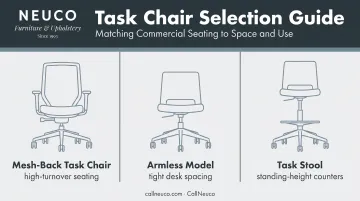
- Mesh-back task chairs — breathable, budget-friendly, good for high-turnover seating
- Armless models — ideal for tight desk spacing in coworking or training rooms
- Task stools — used at standing-height counters, common in labs and reception desks
Where Task Chairs Work Best
Task chairs dominate in environments where the seat changes hands often:
- Hot-desking and coworking spaces
- Reception areas and waiting rooms
- Conference and training rooms
- Healthcare front desks and check-in counters
Flexible workplace design has leaned into this model. LPAS Architecture + Design's Sacramento office (60 employees across 12,000 square feet) was built around unassigned workspaces, with staff moving between project islands and huddle rooms as work shifts, according to a Haworth case study.
That layout depends on lightweight, easily repositioned seating, not chairs tied to a single desk.
What Is an Office Chair?
An office chair — including ergonomic and executive styles — is built for full-support, extended desk work. This is the chair assigned to one person, at one desk, for most of the workday.
Research backs that design choice. A systematic review of workplace chair interventions found that pairing a highly adjustable chair with ergonomics training significantly reduced musculoskeletal symptom growth over 12 months (p=0.012), according to research published via NIH.
A separate field study reached the same result. Training alone — without the adjustable chair — showed no significant benefit (p=0.461), per research on PubMed. The chair does real work, but it performs best with proper setup and training, not as a standalone fix.
Core benefits of office chairs:
- Lumbar support reduces lower-back fatigue over long sitting stretches
- Adjustable armrests and recline reduce shoulder and neck strain
- Full-back support suits employees at a dedicated desk all day
Office Chair Variations
- Executive chairs — leather or leather-look, larger profile, often reserved for private offices
- Ergonomic mesh chairs — breathable, highly adjustable, popular in tech and creative offices
- Big-and-tall models — reinforced frames and wider seats for larger body types
Use Cases of Office Chairs
Office chairs are standard wherever employees are anchored to one workstation for most of the day:
- Private offices and dedicated cubicles
- Corporate headquarters and law firms
- Financial services and government offices
- Any role requiring sustained computer or desk work
These aren't interchangeable with task chairs. A chair that's fine for 90 minutes at a shared desk often lacks the sustained lumbar support a full workday demands.
Task Chair vs. Office Chair: Which Should You Choose?
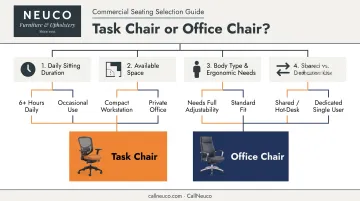
The decision comes down to four factors, not the product name on the listing:
- Daily sitting duration — Under 2 hours per session points to a task chair; 6+ hours calls for an office chair
- Available space — Tight hot-desk layouts favor the smaller task chair footprint
- Body type and ergonomic needs — Larger frames or all-day sitters often need the added adjustability of an office chair
- Shared vs. dedicated use — Shared seating should prioritize durability and easy cleaning; dedicated seating should prioritize personalized fit
Quick rule of thumb:
- Choose a task chair for shared, short-duration, or budget-conscious settings
- Choose an office/ergonomic chair for dedicated, full-day desk roles
For designers and facility managers outfitting multiple workstations, consistency matters as much as function. Mixing five different chair colors across an open floor plan reads as disorganized, even if every chair performs well individually.
A furniture partner who can source coordinated finishes across both chair types keeps the space cohesive without putting premium options at every desk, and still matches the right chair to the right use.
Refresh or Replace? A Smarter Way to Handle Worn Seating
Here's an assumption worth challenging: a scuffed or outdated chair doesn't automatically need to go in a dumpster. In most cases, the frame, base, and mechanical components are still structurally sound. It's the upholstery that's showing its age.
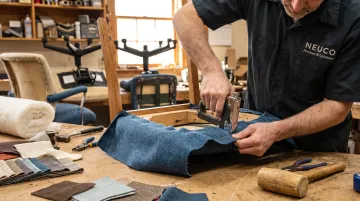
This is where Neuco comes in. As a commercial furniture upholstery and customization partner, Neuco helps businesses and designers refresh existing task chairs or office chairs with new fabric and color solutions instead of defaulting to full replacement. The company works directly with design and architecture teams on projects of any size, whether that's a single reception area or a full office remodel.
Why this matters financially: An MIT-modeled analysis of a commercial office chair (Steelcase's Siento) estimated $768 in savings through remanufacturing versus buying new, against a $1,799 new-chair price point. The same model also avoided roughly 1,350 megajoules of manufacturing energy tied to a brand-new unit, per MIT's Energy Business Modeling research.
That's a modeled case rather than a universal percentage, but it shows how much you can save when the frame and mechanism don't need replacing.
Before assuming replacement is the only option, run through this checklist:
- Frame condition: Is it cracked, bent, or structurally compromised?
- Mechanisms: Do height adjustment, tilt, and swivel still function properly?
- Foam and padding: Is it still supportive, or has it flattened and lost resilience?
- Design fit: Does the current fabric clash with an updated office palette?
If the frame and mechanics check out, reupholstering with new fabric can solve both the wear issue and the design mismatch in one move, often for a fraction of full replacement cost.
Neuco offers both on-site and in-shop reupholstery, giving businesses flexibility depending on project scale and downtime tolerance. And for chairs that genuinely need replacing, the company manages the full process (consultation, ordering through USA-based manufacturer partners, warehousing, delivery, and installation), so there's no gap between deciding what you need and getting it installed.
Practical takeaway: Before signing off on a bulk chair replacement order, get an assessment of whether reupholstery could meet both your budget and design goals. It's often a faster and cheaper path to the same result.
Frequently Asked Questions
What is the difference between a desk chair and a task chair?
"Desk chair" is a general umbrella term. A true task chair is a specific, compact, mobile subtype built for shorter, functional sitting sessions rather than dedicated all-day use.
What is the key difference between a desk chair and a drafting chair?
A drafting chair is taller, built for elevated work surfaces or standing-height counters. A standard desk chair is sized for typical desk height and floor-level seating.
What is the best chair to sit in all day for work?
An ergonomic office chair with adjustable lumbar support, armrests, and seat depth is the best fit for extended daily desk work. Adjustability matters more than any single feature.
Can a task chair be used as a permanent office chair?
For lighter use, yes. Task chairs typically lack the sustained lumbar and postural support needed for full 8-hour workdays, and prolonged use can lead to discomfort.
How do I know when to reupholster vs. replace an office chair?
Check the frame, mechanisms, and foam condition first. If those are intact, reupholstering with new fabric or color is usually more cost-effective than full replacement.
Are task chairs and office chairs adjustable in the same way?
No. Office chairs offer more adjustment points (lumbar support, tilt tension, seat depth) than the basic height and swivel controls on most task chairs.