Yet plenty of businesses stall out designing these spaces. Budgets are tight. Nobody's quite sure where to start. And there's a real tension in hybrid workplaces: how do you build a room that projects authority without walling the leader off from the team?
This guide breaks down what actually matters: the furniture, the layout, the finishes, plus practical ways to refresh an existing office without a full remodel. Whether you're planning new construction or updating a suite that's felt tired for years, you'll find ideas that scale to your budget and timeline.
Key Takeaways
- Desk placement and clearance shape workflow and first impressions more than decor
- Sound masking and acoustic panels give call privacy without isolating executives from staff
- Warm neutrals, layered lighting, and natural elements signal authority better than costly built-ins
- Reupholstering existing seating refreshes a room faster than full furniture replacement
What Does an Executive Office Need?
Every executive office has to do two jobs at once: project credibility and function as a real workspace. That balance comes down to a handful of core elements.
The Desk and Seating That Do Double Duty
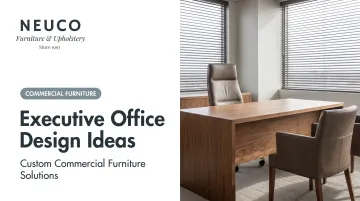
The desk is still the anchor of the room. An oversized or statement desk commands attention. It also gives an executive room to spread out documents, run a laptop and monitor setup, and host a quick sit-down without feeling cramped.
A desk alone can't carry every kind of conversation, though. Pair it with a lounge seating area—a sofa, two armchairs, and a low table—for interviews, casual check-ins, or collaborative sessions that don't need the formality of sitting across a desk.
Storage matters too, though it's easy to overlook:
- File storage for documents that can't live in the cloud
- Discreet space for tech, including monitors, chargers, and video equipment
- Display space for awards, books, or personal items that build credibility with visitors
Privacy Without Isolation
Confidential calls happen constantly in executive offices, but full isolation cuts leaders off from their teams. Two tools solve this without sealing the room shut:
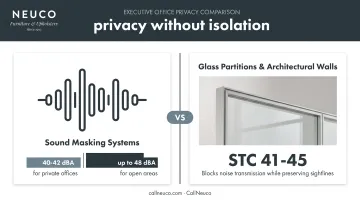
- Sound masking systems — IFMA notes private offices typically run 40–42 dBA (vs. up to 48 dBA in open areas), cutting speech intelligibility without dead silence
- Glass partitions or architectural walls — STC ratings of 41–45 block noise while preserving sightlines
That sightline matters as much as the acoustics. A window or glass panel facing the broader office keeps an executive plugged into daily activity instead of tucked away behind a solid door.
A small hospitality touch—a coffee station or mini bar—rounds out the room and makes it easy to host clients without a trip to the break room.
Neuco produces fabric-wrapped acoustic panels that pull double duty here: they absorb sound to soften a private office, and because they're custom-made, they can match the fabric palette already running through the suite instead of looking bolted on.
Executive Office Layout & Flow
Desk placement is the single biggest layout decision in the room. It shapes daily workflow, and it shapes the impression on everyone who walks in.
The Command Position
Feng shui practitioners call it the "command position," built on prospect and refuge: the executive sits where they can see the entrance clearly while their back is supported, not exposed.
In practice, that usually means angling the desk so it faces the door at a slight offset—not squared up opposite the door, and not with the executive's back to the room. The principle isn't a building code, but people consistently describe feeling more in control of a space when they sit this way.
Clearance and Circulation
There's no universal industry rule dictating exact inches of clearance behind an executive chair, despite what some design blogs claim. What does apply is the ADA's accessible-route standard, which requires a continuous clear width of at least 36 inches, with 32 inches allowed only at short, unavoidable pinch points.
Beyond that baseline, plan for:
- Full chair pull-back distance, including when the chair is reclined
- Visitor-chair depth plus room to pull the chair out and sit comfortably
- Door swing clearance and space for any open file drawers
- A clear path from the desk zone to the meeting or lounge area
Zoning the Room
Treat the office as at least two zones: a focused work area around the desk, and a separate meeting or lounge area for informal conversations. That split is practical: the same room can support deep-focus work and casual collaboration without either feeling like an afterthought.
That zoning connects to a bigger shift in hybrid workplaces. Gensler's 2023 Workplace Survey found that 65% of workers prefer open areas for collaborative work but want private space for individual, focused tasks. Executives aren't exempt from that pattern. Today's strongest executive offices stay visible and approachable, with a door ready to close when a confidential call comes in.
Style & Aesthetic Ideas to Elevate Your Executive Office
Style choices in an executive office aren't just decoration. They set a tone before a single word gets spoken.
Color and Materials
Warm neutrals such as camel, warm gray, or deep taupe tend to read as calm and grounded, while a bold accent wall or contrasting carpet can make a room feel more distinctive. Controlled research on office color hasn't found that specific palettes boost performance or satisfaction on their own. Treat color as a branding and mood decision, not a productivity lever.
Materials do more heavy lifting for perceived quality. A few finishes go a long way:
- Wood veneers on desks and cabinetry for warmth without bulk
- Leather or high-grade performance fabric on seating for durability that still feels premium
- Brass or matte metal accents on hardware and lighting fixtures
Neuco sources upholstery through five established fabric partners: Coral, Fabricut Contract, Stinson, Burch, and Douglass Fabrics. That range gives designers leather, vinyl, and commercial-grade textiles to match an executive suite's palette instead of settling for whatever's in stock.
Lighting, Personal Touches, and Architecture
Layered lighting matters more than most people budget for. The most reliable strategy combines daylight near the desk with dedicated task lighting for evening work and video calls, so the room doesn't rely on one harsh overhead fixture.
Personal touches like awards, curated books, and artwork tied to the executive's background build trust faster than a generic art print. Glass walls and acoustic panels add a modern feel while preserving the transparency hybrid offices increasingly expect.
Bringing in Natural Elements
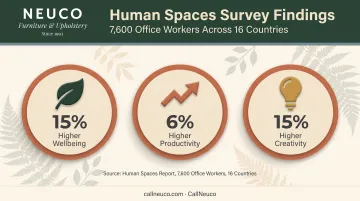
Plants and natural textures soften what can otherwise feel like a stiff, formal room. A Human Spaces survey covering 7,600 office workers across 16 countries found that employees in offices with natural elements reported 15% higher wellbeing, 6% higher productivity, and 15% higher creativity than those without.
A few large plants, a wood-grain credenza, or a stone accent wall can do a lot without competing with the room's formality.
Refresh, Don't Replace: Reupholstery & Custom Fabric Solutions
Not every executive office update needs a moving truck. Reupholstering an executive chair, sofa, or lounge set is usually the faster, lower-disruption way to change how a room looks: new fabric, new color, same well-built frame underneath.
Why Reupholstery Makes Sense
Full furniture replacement means sourcing new pieces, waiting on lead times, and disposing of what's still structurally sound. Reupholstery skips most of that:
- Keeps a frame that's already proven durable
- Avoids the lead times tied to ordering entirely new furniture
- Reduces what ends up in a landfill
Neuco works directly with an executive's designer or architect to match new fabric and color to a rebrand or updated design vision. That collaboration ties upholstery choices to the rest of the space instead of treating them as an add-on.
Minimizing Disruption in a Working Suite
An executive suite can't always sit empty for weeks during a renovation. Neuco offers both on-site and in-shop upholstery service. A chair or sofa can stay in place or go to the shop in Traverse City and return once the work is done, depending on what fits the schedule.
This flexibility matters most for:
- Single statement pieces: an executive chair or sofa that needs new fabric without shutting down the whole office
- Multi-piece refreshes: lounge seating and guest chairs updated together for a consistent look
- Rebranding projects: matching new company colors across existing furniture instead of buying an entirely new suite
For businesses juggling a design refresh alongside daily operations, that flexibility is often the difference between updating this quarter and putting it off for another year.
Furniture & Storage Essentials for Executive Offices
Once the layout and style are settled, the specific furniture choices come down to function.
Choosing a Desk Style
| Desk type | Best for |
|---|---|
| Traditional oversized | Executives who host frequent in-office meetings and need surface space |
| L-shaped | Rooms needing separate zones for computer work and guest seating |
| Sit-stand | Leaders who want height flexibility built into a formal desk setup |
An L-shaped, height-adjustable configuration can pair with overhead cabinets and a wardrobe in as little as 250 square feet, proof that a sit-stand desk doesn't have to sacrifice a polished look.
Chairs and Storage That Hold Up
An ergonomic executive chair isn't optional. OSHA's guidance points to a few non-negotiables:
- Adjustable lumbar support
- Seat depth that supports the thighs without pressing behind the knee
- Armrests that keep shoulders relaxed rather than hunched
Storage rounds out the room:
- Built-in cabinetry to keep the desk surface clear
- Display shelving for books, awards, or personal items
- Integrated cable management so technology doesn't clutter the workspace
Neuco's dealer network sources commercial furniture exclusively from USA-based manufacturers, many based in Michigan, giving businesses a domestic option when specifying desks, seating, and storage for a new or updated executive suite.
Frequently Asked Questions
What are the three main types of office layouts?
The three main types are open-plan, private or cellular, and hybrid/activity-based layouts. Executive offices typically lean private or hybrid: enclosed space for focus, still connected to the broader office.
What is the 3-5-7 rule in interior design?
It's an informal styling guideline, not an industry standard. Decorative objects like books, awards, or plants look best grouped in threes, fives, or sevens, which tend to feel more balanced than even numbers.
What color is best for an executive office?
Warm neutrals and deep, sophisticated tones are popular because they feel calm and grounded, while a bold accent wall can add personality. Research hasn't linked any specific color to better performance, so treat this as a branding decision.
How big should an executive office be?
Size depends on function. Industry benchmarks put senior-management private offices around 190-215 square feet, while offices needing a full lounge or meeting zone often run closer to 250-280 square feet or more.
What is the most important piece of furniture in an executive office?
The desk is usually the visual focal point of the room. That said, the chair matters just as much day to day, since it directly affects comfort and posture through long workdays.
How can I modernize my executive office without a full renovation?
Reupholstering existing seating in a new fabric or color, updating lighting, and adding a few statement decor pieces can transform a room without a remodel. Neuco's custom cushions, for instance, start at $150 with no minimum order.