

Contract furniture is built differently. It's engineered for durability, tested against commercial safety standards, and designed to survive years of heavy daily use that would wreck a typical home sofa or dining chair.
This guide breaks down what contract furniture actually is, what "contract grade" means in practical terms, how it stacks up against residential furniture, who buys it, and how businesses can stretch its lifespan through reupholstery instead of full replacement.
Key Takeaways
- Contract furniture passes commercial safety and durability testing that residential furniture never faces
- "Contract grade" covers frame strength, fabric abrasion ratings, fire codes, and warranty length
- Higher upfront cost typically pays off through lower long-term replacement expenses
- Reupholstery with commercial-grade materials can extend service life without full replacement
- Primary buyers include offices, hospitality, healthcare, education, and government
What Is Contract Furniture?
Contract furniture is furniture designed, tested, and manufactured specifically for commercial and institutional environments, not homes. According to KI's manufacturer definition, it's furniture used in commercial rather than domestic settings. It is built to meet fire and safety standards that residential pieces aren't held to.
The term "contract" doesn't refer to a purchase agreement between a customer and a store. It comes from the business-to-business sales model: designers, architects, and dealers work directly with manufacturers on large-scale commercial projects, rather than a single consumer walking into a showroom.
Common settings where contract furniture shows up:
- Offices and corporate headquarters
- Hotels, restaurants, and bars
- Hospitals, clinics, and senior living facilities
- Schools, colleges, and libraries
- Government buildings and public assembly spaces
Residential furniture is built around comfort and personal style. Contract furniture has a different job. It has to survive high traffic and constant wear while meeting compliance benchmarks that protect occupants in public spaces. KI notes that contract products use different construction specifications to handle that heavier wear.
You'll hear "contract grade" and "commercial grade" used interchangeably. Both signal the same thing: this furniture cleared a stricter bar than anything sold for home use.
What Makes Furniture "Contract Grade"?
"Contract grade" is not a single certification. It combines construction quality, testing, and materials that separate commercial furniture from residential.
Heavy-Duty Construction
Contract furniture uses reinforced frames, stronger joinery, and industrial-grade materials: thicker steel gauge, reinforced hardwood, welded (not just screwed) joints. This is the foundation that lets a piece survive years of daily use in a busy waiting room or restaurant.
Testing Standards That Matter
The furniture industry's main testing body, BIFMA, maintains separate standards depending on the product category — there's no single "pass/fail" contract stamp. Per BIFMA's standards directory:
| Standard | Covers |
|---|---|
| ANSI/BIFMA X5.1 | General office chairs, stools, guest seating |
| ANSI/BIFMA X5.4 | Public/lounge seating (waiting rooms, restaurants, healthcare) |
| ANSI/BIFMA X5.11 / X5.41 | Large-occupant seating, tested at 400- and 600-lb bases |
| ANSI/BIFMA X5.5 / X5.6 / X5.9 | Desks, tables, panels, storage |
| ANSI/BIFMA X6.1 | Student seating, preschool through adult education |
On the fire-safety side, federal rule 16 CFR 1640 adopts California's TB 117-2013 smolder-resistance requirements for covered indoor upholstered seating. That includes reupholstered furniture built after June 25, 2021.
Weight Capacity Differences
BIFMA's large-occupant seating standards test against 400-lb and 600-lb bases. Commercial products reflect those thresholds: Steelcase's Leap and Series 1 chairs, for example, carry a 400-lb rating. There's no single universal residential capacity to compare against. Home furniture simply isn't tested to the same benchmark.
Fabric Grading and Abrasion Ratings
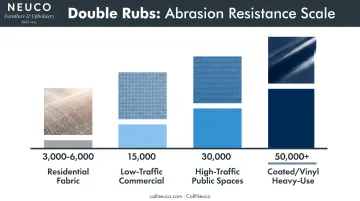
Fabric durability gets measured in double rubs: how many back-and-forth abrasion cycles a textile can withstand before wearing through. The Association for Contract Textiles sets these commercial benchmarks:
- 15,000 Wyzenbeek double rubs: minimum for low-traffic commercial spaces
- 30,000 double rubs: high-traffic public spaces
- 50,000+ double rubs: coated/vinyl upholstery in heavy-use areas
A residential-grade fabric might sit at 3,000-6,000 double rubs. Commercial fabrics start well above that.
Cleanable, Low-Maintenance Finishes
High-touch environments need surfaces that survive constant cleaning. Bleach-cleanable vinyls and stain-resistant textiles are standard in contract fabric lines. Some are rated for 10:1 bleach solutions alongside high abrasion numbers, which is essential in healthcare and hospitality settings.
Longer Warranties
Contract furniture typically carries warranties that reflect real confidence in the build. Herman Miller backs most products with 12 years of parts-and-labor coverage under three-shift, 24-hour use. HON offers full lifetime coverage on qualifying lines. Typical residential warranties rarely match that level of coverage.
Contract vs. Residential Furniture: What's the Real Difference?
Side by side, the gap becomes obvious:
| Factor | Contract Furniture | Residential Furniture |
|---|---|---|
| Construction | Reinforced frames, industrial materials | Lighter materials, cost-optimized |
| Testing | BIFMA category-specific standards | No commercial testing requirement |
| Fabric abrasion | 15,000–50,000+ double rubs | Often 3,000–6,000 double rubs |
| Warranty | 12 years to lifetime (common examples) | Typically much shorter |
| Lead time | Often longer (made-to-order, project-based) | Usually in-stock, quick turnaround |
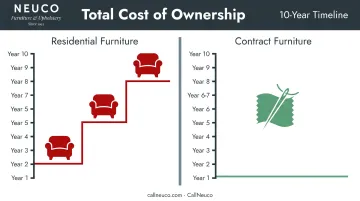
Contract furniture costs more upfront. Over a five- or ten-year window, the math changes. Total cost of ownership usually favors contract-grade pieces once you count what residential furniture costs to replace two or three times, driven by:
- Fewer full replacements over the life of the space
- Fewer repairs under daily commercial use
- Less downtime in restaurants, waiting rooms, and other high-traffic areas
Liability is another real difference. Federal flammability rules under 16 CFR 1640 apply to covered upholstered seating. ADA Section 902 sets height and clearance requirements for accessible dining and work surfaces. Residential furniture isn't built to those specs, which creates exposure if it ends up in a public-facing commercial space.
Who Uses Contract Furniture? Common Industries and Applications
Different industries lean on contract furniture for different reasons, even though the underlying durability requirement is the same.
- Offices: ergonomic seating, collaborative layouts, and furniture that holds up through daily 8-hour use across dozens of employees
- Hospitality: hotels and restaurants prioritize brand-driven style alongside durability, since furniture directly shapes guest perception
- Healthcare: hygiene comes first; BIFMA's G8.1 guideline specifically addresses furniture-surface resistance to cleaning and disinfecting products
- Education: student seating (ANSI/BIFMA X6.1) has to survive rough handling from preschool through university settings
- Government and public assembly spaces: strict durability and safety requirements, often procured through GSA schedules or similar long-term contracts
Neuco's dealer work covers this same range. The company sources and installs commercial furniture for restaurants, hospitals, schools, hotels, offices, and senior living facilities, partnering exclusively with USA-based manufacturers it has worked with for decades.

As businesses renovate or expand, furniture needs shift too. Modular layouts and hybrid workspaces are pushing demand for furniture that can be reconfigured rather than replaced, so flexible contract pieces often outlast a single floor plan.
Refresh vs. Replace: Extending Contract Furniture's Life Through Reupholstery
Here's something a lot of facility managers don't realize: the frame usually outlasts the fabric. A commercial chair or booth built on a reinforced frame can easily last 15-20 years structurally. The upholstery? It might wear out in 5-7 years of heavy use.
That mismatch leads to a common, expensive mistake — replacing an entire piece of furniture when only the fabric has failed.
COM: Choosing Your Own Fabric
This is where COM (Customer's Own Material) comes in. It lets a business select fabric that matches its branding or design vision, rather than settling for a manufacturer's standard offering. Herman Miller's COM program, for example, evaluates non-standard textiles submitted by customers in under 72 hours before approving them for use.
The catch: the replacement fabric has to maintain contract-grade compliance. If you reupholster a restaurant booth with a fabric that doesn't meet the right abrasion rating or flame code, you've downgraded that furniture out of contract status — even though it looks brand new.
Where Neuco Fits In
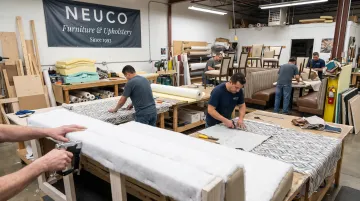
Neuco is a full-service commercial furniture upholstery and customization partner for this exact situation. The company helps businesses refresh or transform existing furniture instead of defaulting to full replacement, with custom color and fabric solutions built for commercial performance.
What sets the approach apart:
- Handles work on-site or in Neuco's Traverse City shop, based on project needs
- Manages ordering through warehousing, delivery, and installation for new construction, remodels, and refresh work of any size
- Collaborates with a client's designer or architect to execute the space's vision rather than redirect it
Neuco has completed more than 1,000 commercial furniture installation and upholstery projects since 1993. The team works with commercial fabric partners such as Fabricut Contract, Douglass Fabrics, and Stinson.
A Traverse City Big Boy manager who's used the company for 17 years described reupholstery repairs as "easy and inexpensive." That result is typical when the frame still has life left in it.
How to Choose the Right Contract Furniture Solution
Before signing off on a new furniture order, or deciding to reupholster instead, run through this checklist:
- Verify certifications. Confirm the piece (or its fabric) meets relevant BIFMA category standards and applicable fire codes for your space type.
- Check the frame and warranty. Ask what the frame material is and how long the manufacturer backs it. Longer warranties usually signal higher build confidence.
- Match fabric grade to environment. A hospital waiting room needs a different abrasion rating and cleanability profile than a corporate lobby.
- Weigh new vs. refresh. If the frame is structurally sound and only the upholstery has failed, reupholstery often delivers better value than full replacement.
- Bring in a consultative partner. A provider like Neuco collaborates directly with your design or architecture team on color and fabric, helping keep the outcome cohesive and on-brand.
Getting this right up front saves you from the expensive cycle of buying furniture that looks fine in a showroom but fails in six months under real commercial use.
Frequently Asked Questions
What is contract furniture?
Contract furniture is furniture designed and tested specifically for commercial and institutional use: offices, restaurants, hospitals, and similar spaces. It's built to a stricter durability and compliance standard than furniture sold for home use.
What is the difference between contract furniture and residential furniture?
Contract furniture uses reinforced construction, passes commercial testing standards like BIFMA, and typically carries longer warranties, often 12 years or more. Residential furniture skips that testing entirely and focuses on comfort and style instead.
What does "contract grade" mean?
It means the furniture has passed specific commercial benchmarks for frame strength, weight capacity, fabric abrasion resistance, and fire safety. It's a performance signal, not a single certification.
Is contract furniture more expensive than regular furniture?
The upfront cost is usually higher, yes. But it tends to even out (or come out ahead) over time, since contract pieces need fewer repairs and replacements than residential furniture under the same heavy use.
Can contract furniture be reupholstered or refreshed instead of replaced?
Yes, and it's often the more cost-effective option, provided the replacement fabric still meets contract-grade abrasion and flame-code requirements. Neuco offers on-site and in-shop reupholstery services designed to keep refreshed furniture within commercial standards.
What industries use contract furniture?
Offices, healthcare facilities, hospitality venues, schools, and government buildings are the primary users. Senior living facilities and public assembly spaces rely on it heavily as well.