

Many Spokane businesses hit the same wall during a renovation or new build. Balancing budget against design vision, and design vision against day-to-day functionality, is harder than it sounds. Furniture that's too generic won't hold up to daily wear. Furniture that's too custom can send costs spiraling before the first chair arrives.
This guide covers what contract design actually means, the services a contract design firm typically provides, how to vet a partner here in Spokane, and what to do when your existing furniture just needs a refresh instead of a full replacement.
Key Takeaways
- Contract design is commercial furniture and space planning for offices, healthcare, education, and government—not homes.
- Choose a Spokane partner with brand authorization, cross-sector experience, and full project management.
- Reupholstering or refinishing existing furniture often costs far less than full replacement.
- Strong local firms pair hands-on design collaboration with layouts that adapt as teams grow.
What Is Contract Design?
Contract design is the practice of furnishing and planning commercial, institutional, and public spaces. It differs from residential interior design, which centers on personal taste and everyday comfort in a private home.
Contract design firms typically serve four core sectors:
- Commercial offices and corporate headquarters
- Government agencies and public buildings
- Healthcare facilities, from small clinics to full hospital campuses
- K-12 schools and higher education institutions
Why Contract-Grade Furniture Is Different
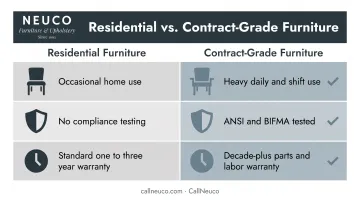
Furniture built for these environments isn't the same as what you'd buy for a living room. Contract-grade pieces are built for heavier daily use, tested for hours of continuous seating and desk activity across shifts rather than the occasional evening at home. Warranties tend to run longer too, often covering parts and labor well beyond typical residential terms.
Compliance matters just as much. Manufacturers test products against ANSI/BIFMA benchmarks for office and institutional seating, desks, and tables.
A hospital waiting room or a busy elementary school puts more wear on furniture in a single year than most homes see in a decade. Those standards are what keep commercial pieces on schedule instead of in the replacement queue.
Design Collaboration and Market Scale
Contract design firms rarely work in isolation. They coordinate directly with architects and interior designers throughout a project, translating blueprints and design intent into furniture layouts, material specs, and installation timelines that fit the building itself.
That collaborative model depends on manufacturers built for commercial scale. Brands like MillerKnoll (Herman Miller, Knoll) are specified often in these projects after decades of supplying office, healthcare, and education furniture across North America.
The category is large: the U.S. business and institutional furniture market hit an estimated $15.2 billion in 2023, according to BIFMA, a modest rise from the year before. That same steady demand is driving growth right here in Spokane.
Why Contract Design Matters for Spokane Businesses
Downtown Spokane isn't standing still. As of late 2023, the core and periphery had 22 public and private redevelopment or new-construction projects underway or planned, worth roughly $252 million combined. Fourteen of the private projects alone topped $118 million, according to the Downtown Spokane Partnership's economic report.
Healthcare and education are fueling a similar push. Washington State University Spokane, for instance, has been planning a health-sciences simulation facility meant to serve 1,200 students, with millions already committed to design work. Projects like this need furniture planned around clinical workflows and classroom sizes from day one, not bolted on at the end.
Hybrid Work Is Reshaping the Office, Not Just the Building
Fewer companies are leasing more square footage. Instead, many are reconfiguring what they already have. National workplace research points to a widening gap: most organizations have adopted hybrid-work policies, yet very few have actually redesigned their space to match. That mismatch shows up fast, usually as too little quiet space or too many desks nobody uses.
For Spokane businesses, this often means:
- Reworking layouts to add shared desks and collaboration zones instead of rows of individual workstations
- Reassessing whether existing furniture fits a smaller, more flexible footprint
- Skipping a lease expansion when reconfiguring current space would work just as well
A furniture mismatch is expensive twice: once to buy it, again to replace it when it doesn't fit the workflow or meet code. Planning commercial, healthcare, government, and education spaces around real use—and code—from the start is how Spokane businesses avoid paying that second cost.
Key Services Offered by Contract Design Firms
Most contract design firms build their services around one goal: making sure furniture matches how a space actually functions. That breaks down into a handful of core offerings.
Space Planning and Layout
This is where projects start. A firm maps furniture to workflow, headcount, and how departments interact. Key factors include:
- Traffic flow through the space
- Growth projections for headcount
- Adjacencies between teams that collaborate often
Get this step wrong and you're redoing the layout in two years instead of ten.
Sourcing, Procurement, and Project Management
Once a layout is set, firms source furniture from established contract-grade manufacturers and manage the process end-to-end. That covers ordering, tracking delivery, and coordinating installation so the project stays on schedule. For a healthcare facility or school, this project-management piece matters as much as the furniture itself, since a delay in one phase can push back an entire opening date.
Firms also stay involved throughout new construction or remodeling, consulting directly with architects and interior designers so furniture selections match the building's design intent rather than getting added as an afterthought.
Refreshing Existing Furniture
Not every project starts from zero. Some contract design services extend to upholstery and repair work that stretches the life of furniture already in use.
Neuco, for example, works with commercial businesses on custom color and fabric solutions for upholstery. That lets a company update existing seating and cushions instead of replacing every piece. The service pairs naturally with a full furniture-planning project, especially when only part of a space needs an overhaul.
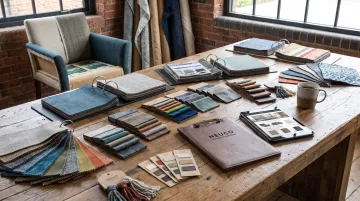
Planning, sourcing, project management, and refresh options together are what separate a full-service contract design partner from a furniture showroom.
Contract Design in Action: A Spokane Case Study
Contract Design Associates has been part of Spokane's commercial furniture landscape since 1980, working across commercial offices, government agencies, healthcare facilities, and higher education for more than four decades.
Its own office tells the story of how the industry has changed. In early 2023, CDA relocated from a 17,000-square-foot space it had occupied for 24 years to 16,000 square feet at 1 N. Monroe downtown, inside the former Spokesman-Review production building.
The new space wasn't just smaller by a thousand square feet. It was designed differently:
- A showroom displaying pieces from MillerKnoll brands
- A reception area, customer lounge, and coffee bar for client visits
- A conference room and sample library for appointment-only meetings
- A dedicated "war room" for focused project work, plus a separate wellness room
That layout mirrors the shift many Spokane businesses are navigating right now: less square footage, more purpose behind each zone.
The takeaway: A contract design partner with decades of local experience typically brings three strengths:
- Authorized access to established furniture brands
- Experience across multiple sectors
- Space plans flexible enough to keep evolving
CDA's own move downtown is a working example of what it recommends to clients.
How to Choose the Right Contract Design Partner in Spokane
Not every furniture vendor operates as a true contract design partner. Before signing anything, run through these checks.
- Confirm authorized dealer status. Working with a firm authorized to sell established contract furniture brands protects warranty coverage and product quality. Herman Miller and Knoll products, for example, often include parts and repair-labor warranties for well over a decade—coverage that can lapse through unauthorized channels.
- Match their sector experience to your project. A firm that's furnished dozens of medical clinics may lack the same depth in higher-education library furniture. Ask for sector-specific examples.
- Confirm full project management, not just sales. A true partner handles ordering, delivery coordination, and installation as one continuous process. If a vendor only sells furniture and leaves logistics to you, treat that as a red flag on any sizable order.
- Ask about collaboration with your architect or designer. If you already have a design team, your furniture partner should be willing to work directly with them, reviewing drawings and specs rather than defaulting to a generic template.
- Check flexibility across project sizes. Spokane projects range from small professional offices to large healthcare and education campuses. Your partner should scale from a handful of chairs to a full-building rollout without dropping quality or communication.
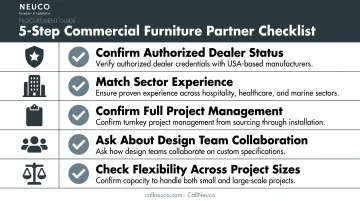
Skip any of these checks and problems tend to show up later—usually as a missed delivery date or furniture that doesn't hold up.
Beyond New Furniture: Refreshing & Maintaining Your Investment
A full renovation doesn't always mean starting from an empty room. Reupholstering and refinishing existing furniture can restore worn pieces for a fraction of what full replacement costs, and it keeps still-solid furniture out of the landfill.
This is where a specialized upholstery partner earns its place alongside a contract design firm. Neuco works with designers and architects to deliver custom color and fabric solutions for commercial furniture upholstery and repair. That can mean restoring seating that needs work, or updating its look with new material to match a refreshed space.
Why Flexible Service Delivery Matters
Partial renovations create a scheduling problem: how do you refresh furniture without shutting down operations? Flexible on-site or in-shop service solves that.
- Healthcare facilities can have seating reupholstered without pulling exam rooms or waiting areas fully offline
- Schools can refresh furniture over a break or in phases, room by room
- Offices can rotate pieces through a shop while day-to-day work continues elsewhere in the building
For any Spokane business weighing a full replacement against a refresh, run the numbers before committing either way. Half the budget often goes further on reupholstery than on an entirely new order.
Frequently Asked Questions
What is the difference between contract design and residential interior design?
Contract design uses durable, code-compliant furnishings built for commercial and institutional spaces. Residential design prioritizes personal style and home comfort, usually without the same warranties or compliance testing.
Do I need an architect or interior designer for a contract design project?
Not always, but it helps. A designer or architect keeps furniture aligned with layout and function, and most contract partners work directly with your design team.
Can existing commercial furniture be reupholstered instead of replaced?
Yes. Reupholstery and refinishing can restore worn pieces and update color or fabric—often a cost-effective alternative to full replacement.
How long does a typical commercial furniture installation project take?
Most projects take several weeks to a few months across consultation, design, procurement, and installation. Full-service partners handle ordering and delivery to keep timelines on track.
What furniture brands are commonly used in contract design projects?
Contract-grade lines such as MillerKnoll (Herman Miller, Knoll) appear often in commercial work. They are widely specified for office, healthcare, and education spaces across North America.
How much does commercial furniture procurement typically cost?
Costs vary widely based on furniture type, brand, and project scale. The best way to get an accurate number is to request a consultation or quote directly from a local contract design partner.